First things first, I think municipalities in Canada have a raw deal and I put the blame squarely on the British North America Act of 1867 which declared them to be nothing more than “creatures of the provinces” with no real power of their own.
It’s a subject I explored back in 2017 when I did a primer on property tax—a regressive tax that hurts the poor more than the rich and is the only tax provinces allow municipalities to levy, albeit while also limiting municipalities’ ability to do so. Here in Nova Scotia, for example, the province decides which properties are exempt from municipal taxes, the province decides how much it will pay in lieu of taxes and the province has decided that Nova Scotia Power will not pay property taxes at all.
I also discussed this subject with Philip Slayton, the former dean of law at the University of Western Ontario, back in 2017. Slayton is the author of a book called Mayors Gone Bad that chronicles the adventures of some of Canada’s worst mayors, but the first thing he said when we spoke was that he was not entirely unsympathetic to Canada’s rogue mayors because the “fundamental vice is constitutional”—Canadian mayors have no real power.
Secondly, I know the situation with the CBRM’s “municipal capacity grant” (what we generally refer to as “equalization”) is farkakte (i.e. so messed up, only Yiddish has a word up to the challenge of expressing it). I wrote about that back in 2017, too. Our grant has been frozen at $15 million while the money we must return to the province each year in the form of mandatory payments for provincial responsibilities like education, housing and corrections continues to grow, touching $21 million last year.
It’s also true that candidate Tim Houston promised to revisit the memorandum of understanding (MOU) that governs the financial arrangements between the province and the municipalities, telling the Cape Breton Post in August 2021:
What I have said is that — as a show of good faith — while those negotiations are happening, we would double the payments to the municipalities. CBRM and others, whoever is receiving the payment from the province now, they would receive twice as much. I think that a $32-million commitment is in our platform, and $15 million of that will go to the CBRM.
Last year he even made good on that promise—but there was no guarantee he would do so again or that the MOU would be renegotiated.
It’s also true there’s something hinky about the “Sustainable Services Growth Fund” introduced in the 2022-23 fiscal year to fund municipal infrastructure projects. As more than one councilor pointed out yesterday, the total spend works out to the $32 million Houston spent on topping up the municipal capacity grants in 2021-22, but instead of receiving $15 million, the CBRM received $3 million—which it was told it could not put toward its operating budget—while Kings County, home to Municipal Affairs and Housing Minister John Lohr, received almost $2 million:
sustainable-services-growth-fund-ssgf-2022-2023-enSo yes, the situation is untenable, but CBRM councilors made it worse last year by introducing a 5%, across-the-board tax cut on the back of a one-off doubling of the municipal capacity grant.
Bruckschwaiger
I took copious notes during yesterday’s meeting but on reflection, I realize there’s no need to inflict that much pain on you. I watched yesterday’s meeting so you don’t have to. Let’s just say the loudest voices in the room were those of the councilors who last year voted for the motion, moved by District 10 Darren Bruckschwaiger, seconded by District 9 Councilor Ken Tracey (who said yesterday that there were people in his district who would “chop your hand off for twenty bucks”) that called on council to:
…reduce the tax rate for all residential and commercial accounts by 5% this year and that no services be cut [or] layoffs because of this motion.
The vote looked like this:
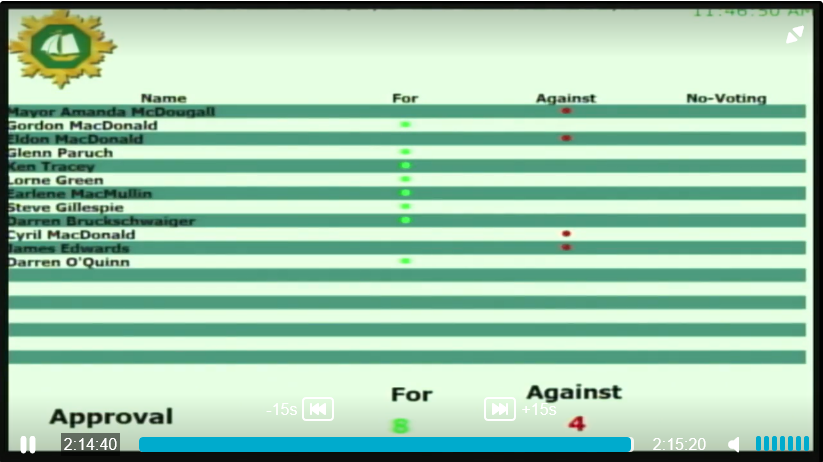
District 7 Councilor Steve Parsons was not in attendance, but sent a message suggesting the cut be phased in, an approach also favored by District 8 Councilor James Edwards.
CBRM CFO Jennifer Campbell had advised against the cut, warning there was no guarantee the $15 million windfall would be repeated in 2022-2023 and estimating the 5% cut could leave a $3.6 million hole in this year’s budget.
But council was determined to “do something for the ratepayers”—although it was acknowledged yesterday that the tax savings enjoyed by corporations like Sobeys and Loblaws and Walmart were not actually passed along to the “ratepayers”—and as a result, it found itself with a hole in this year’s budget which it has been trying to patch since April.
Options
Here’s what Bruckschwaiger said back in April 2022, when he was leading the charge for the cut:
It’s a new day, this here premier promised to double and then…negotiate an MOU. Based on his performance to date, he has been keeping his promise, and I have no reason to think the MOU won’t be complete this year in time for next year’s budget. If not, next year, we’ll do what we always do in every budget, we’ll sit down, review the numbers and decide if we need to raise taxes because of a promise not fulfilled.
Council waived the usual meeting rules yesterday to allow for a freer and fuller discussion of the budget shortfall, which has been whittled down from $8 million, where it stood at the beginning of the negotiations, to $2 million. This allowed Bruckschwaiger to kick things off with a 10-minute opening monologue in which he acknowledged having “led council, somewhat, in that tax reduction,” while also insisting they “did not create” this mess. Having firmly established that it was all the province’s fault, he eventually announced that he was “not afraid of increasing the rate back up” and that if he had known there was a chance the capacity grant wouldn’t be doubled again he “might have had second thoughts” about the cut.
(Bruckschwaiger is really a subject crying out for scientific inquiry: a man who has been in municipal politics for over 30 years and yet still believes campaign promises.)
Raising the base tax rate 2.35% was one of two options Campbell presented on Tuesday to meet the remaining $2 million shortfall:

But the councilors (who were all present except District 5’s Eldon MacDonald) were all over the map during the debate. Some (like Bruckschwaiger and Edwards) were open to raising taxes. Some didn’t want to touch the heavy garbage.
Councilor Parsons argued the CBRM should use its reserves to cover the shortfall. CFO Campbell recommended against this, saying the reserves were for emergencies and would eventually run out, leaving them in an even worse financial situation.

Councilors Edwards, Bruckschwaiger and Gillespie gather around CFO Jennifer Campbell during a break in Tuesday’s budget deliberations.
Parsons then moved that council instruct CAO Marie Walsh and the various directors to cut another $2 million from the budget. Walsh responded “with all due respect,” that they’d come back to council “many times” with suggestions for balancing the budget but council didn’t like any of them and council wouldn’t like the next options they presented either, and in the meantime, they needed a budget.
Parsons’ motion was defeated.
District 11 Councilor Darren O’Quinn tried to introduce a motion that would cover the entire shortfall from reserves and deferred hirings but they had to adjourn to allow him to reword it because he also wanted to get rid of the tipping fees council had already approved in a previous session. His motion was also defeated.
District 2 Councilor Earlene MacMullin and District 1 Councilor Gordon MacDonald were convinced the answer was to reduce overtime and both the fire and police chiefs were dragged to the podium to explain why, in the case of the fire department, it wasn’t contractually possible and in the case of the police it wasn’t recommended. (I have lots of thoughts about the size of the CBRM police force and the fact that, as outgoing chief Peter McIsaac told the CBC in 2021, they have become “the social agency of choice, expected to be first responders to just about anything and everything that happens in our communities,” but slashing the over time budget in a desperate attempt to cover a budget shortfall doesn’t strike me as the best way to address the situation.)
District 6 Councilor Glenn Paruch got mildly obsessed with the question of over-time for snowplow operators.
District 4 Councilor Steve Gillespie took advantage of the waived rules to speak over nine times.
District 12 Councilor Lorne Green received an all-caps text message from a constituent and confronted the CFO with what he clearly felt was a “gotcha” question: why had the budget numbers presented to residents during this year’s public consultation sessions shown a surplus of $16 million? How could the CBRM mislead the public so?
The CFO explained the numbers were the municipality’s last audited figures, from 2021-2022, and they reflected the $15 million top-up of the capacity grant, and the actual numbers for 2022-23 were lower because “council reduced taxes by 5%.”
*Sigh.*
All of this led precisely nowhere.
They’ve decided to ask directors to prepare a list of items that need immediate funding—like the hiring of summer students and heavy garbage and sustainability funding— and then they’ll go back into a workshop and go through the budget line by line to try and cut another $2 million before it must be passed in September.
Councilor Gordon MacDonald, clearly hoping to get out ahead of commentary from people like me, stated he wanted everyone to understand that they’re not just “beating up on the province” rather than doing their jobs but are working hard for the people of the CBRM.
To which I say, in politics, as in writing, it is always better to show than to tell.