Buy buy
Writing about Destination Cape Breton and the Cape Breton Partnership these past couple of weeks has been like returning to earlier, simpler times when publicly funded agencies and their dubious achievements occupied a lot of my brain space.
But it all feels a little darker these days. Tourism is looking more and more like a basket we shouldn’t put all our eggs in—first we lose two seasons to a global pandemic, now we’re poised to lose visitors due to the high price of gas.
Port of Sydney CEO Marlene Usher clearly sees the writing on the wall, she’s turning the port into a mini-mall focused on attracting locals. As she told the CBC:
We’ve been labelled as a cruise pavilion. We want to be more than that.
To be fair, “cruise pavilion” is literally written over their main entrance:
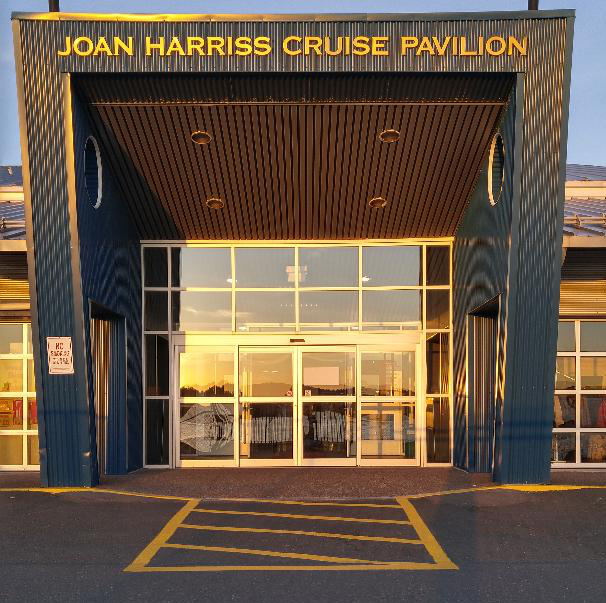
Joan Harriss Cruise Pavilion, Sydney, Nova Scotia
I’m not sure retail is any safer than cruise at this point, given inflation rates. People are struggling to afford necessities, let alone the sort of extras sold by the shops in the Joan Harriss (Not A) Cruise Pavilion.
As for economic development efforts, they have a terrible track record we seem to have collectively agreed to ignore. (Mind you, I understand why: economic development is one of the few things the province is still willing to throw money at, staunch in the belief that, given enough public cash, the private sector will lead us to the promised land of general economic prosperity.)
Boil everything that was said during both council presentations down to its essence and you’ll find that the answer to our woes seems to be for us to buy more stuff. Certainly, that’s what the Port of Sydney is betting on, but even Destination Cape Breton, in this (sort-of) post-COVID season, is focusing a lot of its efforts on trying to get Nova Scotians to “staycation.”
And economic development is all about encouraging people to launch businesses to sell products and services on the local market.
All of which looks pretty shaky in a world where filling your oil tank might require taking out a bank loan and “soaring food prices are forcing more Nova Scotians to use food banks“—and I haven’t even considered the environmental implications of increased consumerism because it’s Friday and I don’t want to be entirely depressing, but one day soon, we’ll have to give it some thought.
Waterfall Season

Mary Ann Falls – Cape Breton Highlands National Park NS (Photo by John Moerk via World of Waterfalls)
I saw the Post story about the access road to Mary Ann Falls in the Cape Breton Highlands National Park being washed out and my immediate thought was, “There goes Waterfall Season,” but how wrong was I?
It seems Destination Cape Breton, the agency trying to make “Waterfall Season” a thing, had already dropped Mary Ann Falls from its list, as CEO Terry Smith told the Post:
[W]e are only featuring 12 waterfalls that are able to be accessed. Some waterfalls, such as Mary Ann Falls, are not being featured as they are not accessible due to the damage of last November’s rainstorm.
Robie Gourd, assistant asset manager for Parks Canada, told the Post there was still “extensive work” to be completed in the aftermath of that November 2021 storm which saw “more than 280 millimetres of rain pummel eastern regions” of the park.
CBC meteorologist Ryan Snodden characterized the rainfall as “incredible” but it was actually in line with what we’ve been told to expect as the planet warms and it points to another big question mark hanging over the tourism industry: climate change.
Gourd said they still had significant repairs to make as a result of the November storm and were doing the best with the resources they had. Will there come a point when we have to use funds earmarked for marketing the Cabot Trail to repair the Cabot Trail?
(I have to note that I stopped writing in the middle of this item to go to the store for milk and when I turned on the car radio I heard—no word of lie—TLC’s “Waterfalls” with a chorus that begins: “Don’t go chasing waterfalls…” Coincidence?)
Radio Gaga
That TLC song was on an album released in 1994 but it was actually the newest song I heard on my milk run, during which I was also treated to “Higher Love,” released by Steve Winwood in 1986; and “December 1963 (Oh, What a Night),” released by Frankie Valli & the Four Seasons in 1975.
I like hearing the odd old song, but a steady stream of oldies makes me want to stop the car and sell the radio and in this I am…pretty much on my own.
I looked up the stats on commercial radio and according to an Ipsos study completed for the CRTC in 2020:
Four in 10 Canadians are listening to commercial radio daily – the most of any broadcast platform, while seven in 10 (68%) say they’re listening weekly, according to newly-released CRTC report, Attitudes and Opinions Towards Commercial Radio in Canada.
Moreover, 64% of respondents access the platform specifically for music.
The most recent Canadian Radio-television and Telecommunications Commission (CRTC) breakdown of the English-language radio market by format is from 2019 and it looks like this:

Source: CRTC
Although News/Talk radio outstrips any one music format, all the music formats taken together total 61% and Adult Contemporary’s 12% share puts it very close behind CBC Radio One’s 14% (I lost the interactive feature when I copied the chart but if you view it in the report, you can see the percentages). “Adult Contemporary,” in case you’re wondering, used to be “Easy Listening” and both are basically euphemisms for “old.”
The CRTC doesn’t break down audiences by age, but I read elsewhere that radio audiences skew older and they seem to like listening to the music they listened to in high school. What’s more, they may have some science on their side.
Writing in Psychology Today, Christopher Bergland cites some recent (admittedly small) studies that have found that:
…listening to music engages broad neural networks in the brain, including brain regions responsible for motor actions, emotions, and creativity.
In the first study of its kind, Amee Baird and Séverine Samson, from the University of Newcastle in Australia, used popular music to help severely brain-injured patients recall personal memories. Their pioneering research was published on December 10, 2013 in the journal Neuropsychological Rehabilitation.
According to MIC magazine, this is something musicians have known forever:
“There’s no way you can compete with your early records as they’ve resonated with people because they have time to seep into people’s lives,” Jeff Tweedy of Wilco said in 2011. “A new record is immediate, and something immediate will never have the same set of emotions as something that’s been able to accumulate emotions over a long period of time.”
So, in short, I should shut up and let everyone enjoy their oldies—and I will, right after I add this caveat, per Bergland:
Interestingly, it appears that if you haven’t heard a song in years, the neural tapestry representing that song stays purer and the song will evoke stronger specific memories of a time and place from your past. The memories linked to overplayed songs can become diluted because the neural network is constantly being updated.
Let’s get real, though, commercial AM-FM radio is more interested in selling advertising than protecting my neural tapestries, so I won’t expect them to vary the playlists anytime soon. Portia Sabin, president of the punk rock label Kill Rock Stars, offers some interesting insights into the problem—which plagues new music as much as old—in the interview below:
A final thought: did you notice that the only country format in the CRTC chart above is “Today’s Country?” As in, very definitely not “Yesterday’s Country?”
Apparently, country radio’s preference for new music has been a contentious issue for some time and things came to a head back in 1998, when Johnny Cash won the Grammy for Best Country Album for the Rick Rubin-produced “Unchained” album.
Rubin took out this full-page ad in Billboard:

(The photo of Cash flipping the bird that was taken by photographer Jim Marshall during a concert at San Quentin prison in 1969, after Marshall asked Cash to “do a shot for the warden.” You’ve probably seen it, but it apparently wasn’t well known in 1998.)
As the Songfacts website explains:
…Cash got the Grammy win even without support from country radio, which had little use for the aging legend on their playlists. But while country stations remained enamoured with the likes of Shania Twain and Garth Brooks, Cash found a wider audience with Unchained, which had cross-genre appeal.
Writing about the ad (and the stir it caused) in Billboard on 4 April 1998, Chet Flippo said:
One interesting point is that Cash’s album and singles were not serviced to country radio, so this hissy fit by Cash’s record company in complaining that radio ignored them is a tad silly in that regard. I personally find it deplorable that many of my musical heroes aren’t allowed on country radio, but I think it’s a debate that should rise above the adolescent level.
I mean, he may have a valid point but I doubt he’d have been writing about the issue at all if not for Rubin’s hissy fit.
Other older country artists, like Willy Nelson and George Jones, apparently loved the ad.
I like older country so I’ve managed, in the course of one morning, to bring myself from complaining that old “Adult Contemporary” songs are played too much to complaining that old country songs aren’t played enough which is surely a sign that I should step away from the keyboard for a bit…