Innkeeping
In terms of sheer words per minute, I think Episode 11 of Annette Verschuren’s Bet On Me podcast — “The Power of Place: The connection between culture and economy with Zita Cobb, Innkeeper of Fogo Island Inn” — has to be the winner.
Because man, can Zita Cobb talk.
I suspect it helps that she’s told her story so many times she could probably recite it in her sleep. In case you’re not familiar with her Fogo Island project, it’s a high-end inn on an Island off the coast of Newfoundland that is furnished and decorated with locally made products. As the website explains:
Many luxury properties have a charitable foundation. Our charitable foundation has a luxury Inn.
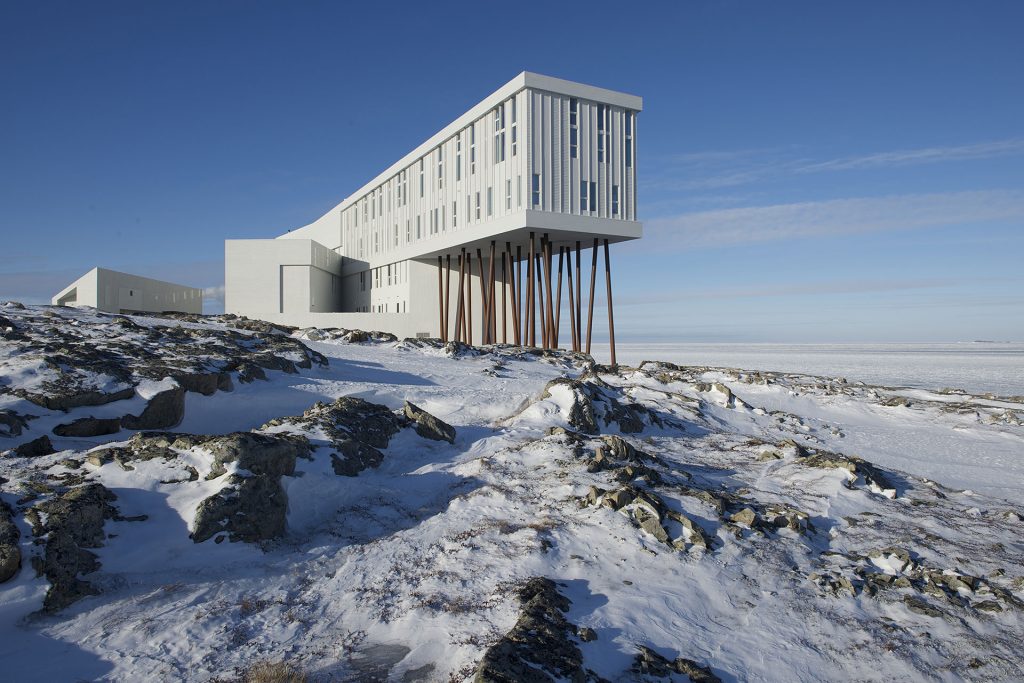
Fogo Island Inn
The charity, Shorefast, founded by Cobb and two of her six brothers, is:
…dedicated to helping to secure a resilient economic future for Fogo Island, Change Islands, and similar rural communities worldwide. All surpluses from the operation of Fogo Island Inn are reinvested in the community of Fogo Island, through the projects and programs of Shorefast. There is no private benefit.
Cobb, like Verschuren, has had a late-onset epiphany about the need to protect the environment and the danger posed by old ways of doing business, i.e. the ways by which both of them made their fortunes.
Cobb started out as a production accountant for Texaco and Shell in Calgary and what turned her off the job was not the fact that it was with an oil and gas company — “these are important jobs, we need oil and gas companies” — but that it was in Calgary, a place she couldn’t connect with. At least, I think that was the problem, what she actually said about the Calgary job was that she “couldn’t figure out how it related to place.”
And “place” is very important to Cobb, whose first line to Verschuren is:
Annette, thanks for having me. It’s a real pleasure to talk to you about anything but especially about the most important thing which is place, place, place, PLACE.
Cobb and Verschuren exchange thoughts about their respective “places” — Cobb was born on Fogo Island and Verschuren…well, surely by this point you all know where Verschuren was born. But it is funny, I think, that Cobb is doing the interview from Ottawa. Even funnier is the explanation she gave for sitting out the pandemic in the nation’s capital in a June 2021 interview with former Globe and Mail editor-in-chief now RBC VP John Stackhouse:
I’m in Ottawa. I’ve been in this frickin’ chair for 15 months, and it’s like a cockpit. I’ve been faced with the choice of ‘where do I put myself for this time?’ And I elected to put myself where there was the best Internet.
Which suggests the internet is not so hot on Fogo Island which probably adds to the other-worldly experience for the high-fliers who visit but can’t be much fun for the locals. Speaking of that experience, Verschuren, who has “had the privilege of being” at [Cobb’s] magnificent inn a number of times,” gives a characteristically batty description of it:
There is no place that can take that garbage that you have, stirring around in your head, and removing it and letting that full body be part of this place.

(I apologize for jumping all over the place and not reporting this conversation as it actually flowed but listening to it was like being hit by a word tsunami. I’m still picking adjectives out of my hair.)
Back to Cobb’s “journey.” She left the oil and gas company and “joined a little tech company” that focused on “cold regions tech,” which is how she came to fall in love with the Arctic. She has now, she says, become a hiker “and we mostly go to the Arctic to hike.” (Don’t we all, Zita, don’t we all?) She left this company for JDS Fitel (then JDS Optics later JDS Uniphase Corporation). The company had 89 employees when she joined in 1989 “and the darn thing grew into 40,000 people” by the time she left in 2001, taking her money (she must have cashed in on the merger with Uniphase) and going “home” to Newfoundland.
(Despite her own success in the world of business, Cobb thinks all the business schools should be closed because they’re creating “dangerous people” armed with “tools of mass destruction of culture and nature.” Verschuren asks Cobb if she disagreed with “a lot of the crap” she was “fed” in business school and says she herself has had “many MBA students” work with her and she has to “unteach them some of the things that they’ve learned,” which is very interesting coming from the chancellor of a university with a business school.)
There is a lot of palaver about Mother Earth and resources and “environmental logic” but at the heart of Cobb’s success lies an inconvenient truth: her “luxury” inn relies on the continued existence of a monied class who can afford to fly to Newfoundland and pay for a three-night (perhaps soon to become a four-night) minimum stay at rates that range from $2,575 per night to $5,075 per night to “price available upon request.” (The change from a three-night to a four-night minimum is being considered in the name of — wait for it — lowering guests’ carbon footprint.)
People who will pay $950 for a “sweetheart puppy” table from the Fogo Islands Workshops:

Source: Fogo Island Workshops
Actually, I need to quote that June 2021 interview again, because she elaborates further on the advisability of a three-night minimum:
The longer people stay, the better it is for them and the better it is for us because it’s just less churn, fewer transactions. Travel should not be about transactions. What we need is travel that is about relationships.
Exactly, travel should not be about three $5,000 transactions — it should be about one, $15,000 transaction. I think the Buddha said that.
The “resiliency” of her scheme was tested — and found wanting — by the pandemic. Her hospitality-based business (which attracts only 5% of its guests from Atlantic Canada) proved as vulnerable to the plague and as reliant on government assistance as any other. As she told Stackhouse:
Our work is about economic dignity, so for us to have to lay off people because we simply couldn’t open was the most gut-wrenching, heart-destroying thing. We live in Canada, so there were enough programs that people didn’t starve to death, but nobody wants to be thrown out of work for 15 months.
I find the speed with which she moves from employees living a life of “economic dignity” to employees “not starving to death” kind of breathtaking — and knowing she’s saying it from Ottawa where she’s riding out the pandemic with her good internet makes it all the more dazzling.

Source: Fogo Island Inn website
But she does say the darnedest things, like:
There’s very little to know about me, Annette, that you can’t figure out by studying the codfish very closely.
Asked to elaborate she cites characteristics like pragmatism and stubbornness which I have never heard attributed to the codfish, but I guess I’ll take her word for it, although I was hoping the similarity would be that she, too, had three dorsal fins and a chin barbel.
Verschuren asks:
In 10 years time, tell me, in your…amazing mind and world, what what are you doing in ten years’ time?
Cobb says they will have “solved” Fogo Island’s housing crisis and lack of daycare. Welcome news to anyone needing daycare and a house right now, no doubt.
But I will end as Verschuren did, with high praise for Cobb:
You have the real key, you’re doing it. You’re doing it. Not just talking about it. Some people talk about this shit and don’t do it. You’ve done it. You’re doing it. And I’m just so privileged to have the opportunity to spend a few minutes with you, Zita Cobb.
Why just talk about this shit when you can do it?
Words to live by.
Nova Scotia (Solar) Power
So, Nova Scotia Power has asked the UARB to allow it to charge homeowners who have net-metered solar installations a fee of $8/kW/month. According to the non-profit Solar Nova Scotia, “a homeowner with a 10kW system generates about $1,760 worth of electricity per year. They will be required to pay NSP $960 per year.”
The request is part of a package — including a 10% hike in residential power bills over the next three years — submitted by the company on Thursday, (Jennifer Henderson, who keeps an eye on all things NSP for the Halifax Examiner, has the details).
I haven’t had time to do much research, but the reaction to what the company is calling a “system access charge” for homeowners with solar installations has been loud and negative — the general sentiment being that the company wants to “strangle” solar in its cradle.

Photo by Pujanak, Public domain, via Wikimedia Commons
Here’s a helpful analysis of the situation from Sarah Riley of R&G Sustainability, who took to Twitter to contend that Nova Scotia Power isn’t building “utility-scale solar because it’s more profitable to burn coal.”
Without the possibility of purchasing solar-generated electricity from NSP:
…homeowners are stepping up, taking it upon themselves to build distributed solar, yes for the savings, but I’ve also never met a solar roof owner who wasn’t also doing it because they care about the planet and our future, and know it’s the right thing to do.
And now NSP proposes to hit them with a hefty fee for the privilege of generating their own power.
It seems so egregious on the part of NSP that I find myself agreeing with another Twitter user:
Did NSP try to raise rates to distract from their attempt to scuttle solar power, or are they trying to scuttle solar power so they can sneak in the rate hike?
— Sunil Sarwal (@SunilSarwal) January 28, 2022
Sour notes
A recent Nova Scotia court decision caught my eye, because it constituted a rather dark sequel to what was originally a pretty sunny story.
I remembered the original story well — it was the tale of world-renowned Hungarian organist Xaver Varnus buying a pipe organ in Truro and having it installed in the Pilgrim United Church, which he’d also bought, in Brooklyn, NS, with plans to establish an international organ festival. Varnus’ story got a lot of publicity, including an interview with the CBC’s As It Happens which billed him as the organist who “pumps out Bach in his pyjamas.”
Varnus himself created a video about the process of reassembling the 24-stop Casavant organ that was posted to YouTube on 29 October 2020.
Varnus hired a local company, Acadia Pipe Organs Ltd, to handle the work of “disassembling, transporting and assembling the instrument.” A price of $28,000 was agreed and the work took place in October 2020.
But Varnus paid only $17,000 of the promised $28,000, and when he was presented with an invoice for the outstanding balance of $15,200, he claimed Acadia Pipe Organs had not done all the work they’d been contracted to do. Colin Walsh, the owner of the company, took Varnus to small claims court.
Adjudicator Darrel Pink ruled in favor of Acadia Pipe Organs Ltd on January 23, saying they had a contract with Varnus and they’d completed the work outlined in the contract.
The decision makes for interesting reading — Varnus dismissed his lawyer and represented himself. There is a rather confused reference to a Hungarian translator (the decision says it was requested by the claimant despite his “fluency in English” — but the “claimant” was Acadia Pipe Organs, so I have to think it was the defendant, Varnus, who requested the translator. In any case, the request was denied.)
Pink says experts provided a “significant amount of technical evidence regarding the workings of a pipe organ” and that they were “interesting and instructive to the Court.” One example had to due with the difficulty Walsh had tuning the organ, as the Brooklyn Church was:
…an uninsulated building alongside the ocean. Mr. Walsh, who was responsible for ‘tuning the organ’ indicated that given temperature fluctuations in the Church, due to a poor heating system and the absence of insulation, though five attempts were made, the organ would not hold its tuning. He stated the normal temperature for tuning is a stable temperature of around 70 F. but when they were trying to do it the Church was as cold as 50 F with fluctuations. His evidence was that if a steady temperature was maintained in the Church, the organ would hold its tuning, but without that the organ would not remain tuned.
In the end, as noted, Pink ruled in favor of Acadia Pipe Organs and awarded damages of $15,200 plus court costs bringing the total to $15,943.80.
[Adopts best Paul Harvey voice]
And now you know the rest of the story…