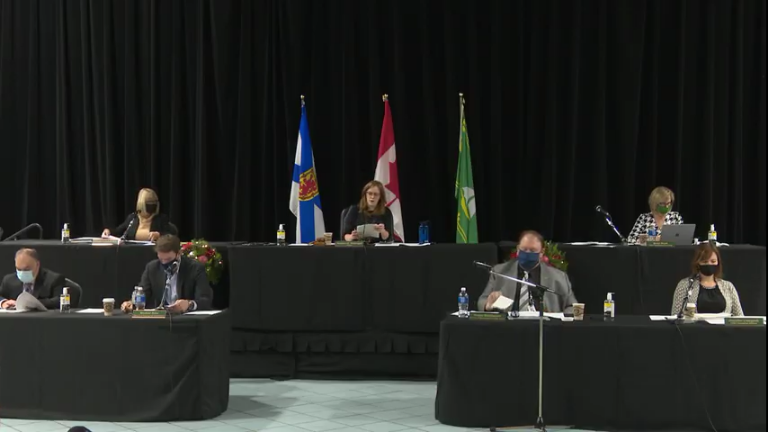
The first episode of the new season of CBRM Council was three hours long, featured a bunch of new characters and offered up at least one new twist in an old plot. It seems to have been filmed in a black light theater although, sadly, none of the councilors took the opportunity to wear a fluorescent costume (or mask). Maybe next month.
Although the cast skews as male as an Aaron Sorkin drama, the main characters are both women — last night District 2 Councilor Earlene MacMullin was acclaimed deputy mayor, joining Mayor Amanda McDougall at the top of the municipal ladder.
Some things have been carefully preserved from the last council — I mean besides Councilors MacMullin, Eldon MacDonald, Darren Bruckschwaiger and Steve Gillespie. One of those things is a penchant for unnecessary secrecy, which has been a burr under my saddle since I began paying attention to local politics. I offer you five examples:
Take a load off
Things kicked off with an in camera meeting to discuss the awarding of the food and beverage contract for the Miners Forum in Glace Bay. Optically, I have to say, this was not a good look, even if you accept that such deliberations cannot be carried out under the watchful eyes of the nosey, nosey public (and I, for one, think this is precisely the sort of discussion that should be held in public so we can understand how council reaches decisions like this.) As it played out last night, council didn’t explain its decision or even discuss its decision — it just voted on it. And it voted to award the contract to a numbered company — 3341020 NS Ltd.
Fortunately for me, I have access to a magical service called “the internet,” so I looked 3341020 NS Ltd up in the NS Joint Stocks registry and discovered it is owned by Angela Houston. I then googled Angela Houston and found out she’s director John Houston’s daughter, known for her portrayal of Morticia in The Addams Family movie. I then realized Google was talking about Angelica Houston and that Angela Houston is the owner of the Talo Cafe Bar on Commercial Street in Glace Bay. Why her name could not be spoken aloud in council baffles me.
Agenda
The agenda for Tuesday night’s meeting — I mean, the full agenda, with the Issue Papers and the memos and the diagrams and the motions attached — wasn’t posted until Tuesday. And even then, items were missing. (Like the actual motion awarding the Miners Form concession to 3341020 NS Ltd, which I guess was left out because they didn’t want to lose the element of surprise during the meeting?)
According to an amendment to the council’s agenda policy approved in June 2018:
The deadline for regular agenda items to be submitted to the Clerk’s Department shall be 4:30 p.m. seven days preceding the meeting.
If this is the case, I don’t see why I shouldn’t be able to see the complete agenda — documents and all — by at least the Friday preceding the meeting. As a reporter, that would give me time to read it, think about the issues I particularly want to cover, maybe do some background research. I can’t really do this when I don’t receive the full agenda until the day of the meeting.
But as a friend pointed out on Facebook, this is a disservice to the public, which doesn’t know what council will be discussing until the day of the meeting.
Grants policy
Back in May, CAO Marie Walsh asked council to “deviate” from its Municipal Grants Policy to allow non-profit and charitable organizations to apply for funding to address shortfalls in their operating funds. The municipality stipulated that to qualify, the organizations had to get matching funds from the province.
Last night, Walsh asked that they deviate from their deviation and provide the municipality’s share of the funding — 50% — to eight organizations that had failed to secure provincial funding. (Five of these have been approved for municipal funding, three need to provide additional financial information.)
I have no problem with this, charitable organizations and non-profits are doing a lot of the heavy lifting in this pandemic, and it’s not as if we’re talking lordly sums here: the total for the five organizations that have been approved is $21,000 and the total for the three pending is $15,000. Walsh noted that the money has been budgeted.
My problem is this: they didn’t name the organizations. They held this entire discussion and voted, ultimately, in favor of Walsh’s proposal, without once naming the organizations.
Lyceum
The Lyceum, a CBRM-owned building on George Street in Sydney, was not on the agenda last night, but it came up in a discussion about Sacred Heart Church (about which, more later).
District 5 Councilor Eldon MacDonald said, in passing, that he has been working with an unnamed group with an unnamed proposal for the building for “two years.”
This might be an excellent proposal from an excellent group, but shouldn’t we at least be given an inkling as to what they have in mind for a public building?
Second berth
Port of Sydney CEO Marlene Usher revealed that there is a problem with power delivery to the second berth which means the structure, which was supposed to have been ready to service cruise ships this spring, is not yet operational.
A Tale of Two Amendments
I just heard the CBC’s Tom Ayers make the point I was about to make about two planning amendments discussed last night, so if my take on it sounds suspiciously like his, that’s why.
Basically, two developers jumped the gun and did work without the proper permits — Carlene Scafidi in South Bar converted an “accessory building” into a single-detached dwelling while Kevin Colford, owner of the Highland Arts Theatre (or, as he was memorably described by one councilor during the discussion, “the spearhead child of the HAT”) began renovations on Sacred Heart Church, which he intends to turn into a “high-end” dinner theater/events venue.
The Staff Paper on the Sacred Heart case failed to mention a rather salient point, one brought out by District 4 Councilor Steve Gillespie, who said he’d seen photos of the building interior and the completed renos seemed substantial. In answer to a question from Gillespie, Planning Director Michael Ruus admitted that Colford had received a stop-work order from the municipality in March, and the planning department has been working with him since then to get the project back on track.
The problem with the Sacred Heart project is parking — the applicable zoning by-law calls for 80 parking spaces for a venue this size and there is no room on the property for an 80-space parking lot, nor is there sufficient street parking. Colford is in the process of seeking provincial Heritage Status for the building, which has municipal Heritage Status, but during the discussion it was suggested this process could take up to two years. Provincial heritage properties are exempt from “parking, lot development, and site plan approval requirements.” Colford is asking the CBRM to extend this exemption to municipal heritage properties.
Council decided to conduct a Public Participation Program (PPP) to discuss the changes, but seemed generally well disposed toward the project, despite the bit of bother about the permits.
In the South Bar case, however, councilors mostly preached the, “We have rules and they must be followed” gospel and voted to decline Safidi’s request to amend the CBRM Land Use Bylaw to allow more than one main residential dwelling on a lot. Kristen Knudskov of the planning and development department (who may I say in passing, has a real gift for explaining things) said that prior to the introduction of the LUB, there were a number of cases like this in the CBRM and they were “rife with title, mortgage and property insurance problems for subsequent generations of owners.”
Council voted to decline the request.
I actually think their reasoning in both cases made sense, but it also demonstrated that “We have rules and they must be followed” is not how development is done in this town (or probably any town). It also demonstrates that some of the municipality’s planning rules are outdated, which is probably why the planning department is in the process of conducting a comprehensive review of all planning policy and by-laws.
In Port We Trust
Port of Sydney CEO Marlene Usher appeared before council to present the Port’s sad financials — with the loss of cruise, which is 75% of its business, it was $550,000 in the hole before amortization as of September 30, and is down $950,301 after amortization.
To cover its operating expenses, the Port board wrote to ACOA (the organization from which Usher has been seconded) and asked that it be allowed to use the money left over from the 2012 harbor dredge to fund its operations. These monies — totaling $1,112,180 — are contained in a Trust Fund. Usher explained that the fund had originally been overseen by the Sydney Ports Corporation and when that organization was replaced by the Port of Sydney Development Corporation in 2015, control of the fund passed to the new corporation. The terms under which the monies — $2,514,185.61 at the time — were to be spent were spelled out in something called the Assumption Agreement. Last night, Usher summarized those terms this way:
- Repair and maintenance of the Confined Disposal Facility
- Installation of Navigation Aids
- Other Port projects
But this is not quite correct, as I know, because I was deeply obsessed with this fund and its uses for an unhealthy period of time. Here’s what the actual agreement said about how the monies were to be used:

Source: ECBC-SPC Assumption Agreement
See that? “Other port projects” were only to be funded after the other obligations — including the navigation aids — were met.
But the reason the balance in the fund today is $1,112,180 is that in 2015, the Port went to something called the Sydney Harbour Oversight Committee (which had overseen the dredge project) and asked that it be allowed to “reallocate” the monies earmarked for navigational aids to “business development.” It even presented a budget to show what that reallocation might look like:

Click to enlarge
The steering committee approved this, although Joe Cashin of ACOA Cape Breton stated that “an amendment to the ACOA contract” was being considered to “reflect the name change from Sydney Ports Corporation to Port of Sydney Development Corporation and to cover the reallocation of the remaining funds.”
In 2017, I searched high and low for a copy of the amended contract but I never found it because, I am quite convinced, it didn’t exist.
Asked (by me) on what authority the Port of Sydney had reallocated those funds (it would ultimately spend over $1 million on “business development” in support of the container terminal project — a project that has since been removed from its remit), Usher pointed me to the steering committee decision and a “legal opinion” she’d received from Breton Law’s Jim Gogan, whose firm would be paid $149,040 in legal fees from the assumption fund. Usher wouldn’t share the opinion with me.
I had thought reallocating the funds would require an amendment to the Assumption Agreement, but I now see that the “ACOA contract” Cashin referred to may have been the original statement of work for the dredge issued in 2011.

Port of Sydney CEO Marlene Usher. (Source: YouTube)
At any rate, that’s the document ACOA has now agreed to modify to include operating costs of $1.6 million in the “estimated eligible costs” for the project. It’s like they went back in time to 2011 and made operating expenses an eligible cost of the actual dredge project. So it doesn’t matter what the Assumption Agreement says about how “leftover” funds are to be used, these are costs associated with the original project. I think it may be pure genius although it also seems really hinky — could they have added anything as an “eligible cost” to the 2011 statement of work? (And why $1.6 million if there is only $1.1 million left in the fund? Are they retroactively approving some of their spending on “business development?”)
The only condition ACOA put on this was that the CBRM had to sign off on it, which is why Usher was before council last night.
Usher claims the Port has cut all the “discretionary” spending it can — some staff has been laid off and those remaining having taken pay cuts, including Usher, apparently. She has something of a flair for the dramatic, though, telling council that without access to this money, the Port could be forced to close its doors and then the fuel tankers would be unable to dock, the implication being that everyone in CBRM who heats with oil would freeze this winter, but council didn’t really seem to buy this.
In fact, Usher faced some hard questions from District 10 Councilor Darren Bruckschwaiger about the Port’s failure to diversify its income sources, and she didn’t have much to offer in response, other than that the board has lots of ideas but they won’t be sharing them until the AGM. (In case you don’t know this, the Port Corp has one shareholder — the CBRM.)
In the end, however, council approved Usher’s request by a vote of 12 to 1, most councilors expressing confidence the cruise trade would return and this was just a question of tiding the organization over.
The holdout, though, was District 8 Councilor James Edwards, who also had some hard questions for Usher about the Port’s viability.
Edwards is a former CRA employee who told the Post in his candidate’s interview that he spent his 34-year career conducting “Trust Account Examination, visiting business, reviewing books and records and counselling on relevant government legislation.” If anyone on council can get to the bottom of the Port’s finances, perhaps he can.
Oh, and as for 2021, Usher says bookings are “strong,” although this could change by next spring and they’ve already had cancellations by Holland America and Princess lines. Moreover, any vessels that do arrive will be traveling at reduced capacity. In short, Usher says the Port may see a “fraction” of its usual business next season.
Term Limits
District 4 Councilor Steve Gillespie set the fox among the chickens with a resolution calling on mayor and council to write the Department of Municipal Affairs for advice on the introduction of term limits.
Will it surprise you to learn that District 5 Councilor Eldon MacDonald, embarking on his third term, and District 10 Councilor Darren Bruckschwaiger, embarking on his sixth (five-and-a-half, really, he quit in 2014 to go out West before returning to run again in 2016) do not support term limits?
Bruckschwaiger feels it should be left to the electorate to impose term limits.

CBRM Mayor Amanda McDougall swearing in District 4 Councilor Steve Gillespie at the 24 November 2020 meeting of the CBRM Council. (Source: YouTube)
Eldon MacDonald cited the example of Bill Clinton being replaced as president of the United States by George W. Bush. Were it not for term limits, which prevent a US president from seeking a third consecutive term, said MacDonald, America might have enjoyed four more years of this “excellent” president. (I’m assuming MacDonald sees himself in the Bill Clinton role rather than the George W. Bush role in this scenario). The argument fell flat with me because, although I’m no fan of W, I’ve read too much lately about Clinton’s legacy — welfare cuts, financial sector deregulation, NAFTA and mass incarceration — to think he deserved another four years.
There are pros and cons to term limits, but having just waved farewell to a number of councilors who were first elected 25 years ago, I agree with Gillespie it’s a discussion worth having.
In a funny postscript to this story, I heard Tom Ayers this morning say he’d asked Municipal Affairs about term limits and was told there was nothing in the Municipal Government Act allowing them or forbidding them and that their advice to the CBRM would be to seek “independent” legal advice.
Finances
The CBRM is weathering the pandemic better than expected in financial terms, according to Chief Financial Officer Jennifer Campbell, who said a surge in deed transfer tax revenues, driven by the municipality’s booming housing market, has helped the municipality out to the tune of $718,200.
As of September 30 — the mid-point of the fiscal year — Campbell said all departments are reporting figures “less than anticipated” in the budget.
COVID costs (sanitizing, PPE, etc), however, are at $850,000 as of November 24. Campbell said they had budgeted $810,000 for the fiscal year, so will be over budget.
But “so far,” she said, “we are looking okay.”
Last year, by end-September, she said, the CBRM had “burned through” 41% of its annual budget. This year, even with COVID pressures, they are at 43.6%.
Campbell also noted that the CBRM has received $3,929,632 from the federal government’s Safe Restart agreement to help municipalities with “incremental COVID pressures.” That money is in the bank.
Finally, she reminded council that the municipality had expected to use $2.5 million from its reserve funds to offset its losses but she now hopes that with careful management, the federal financial assistance and “maybe even a little bit of luck,” it may not be necessary to dip into these funds, or at least not to dip so deeply.